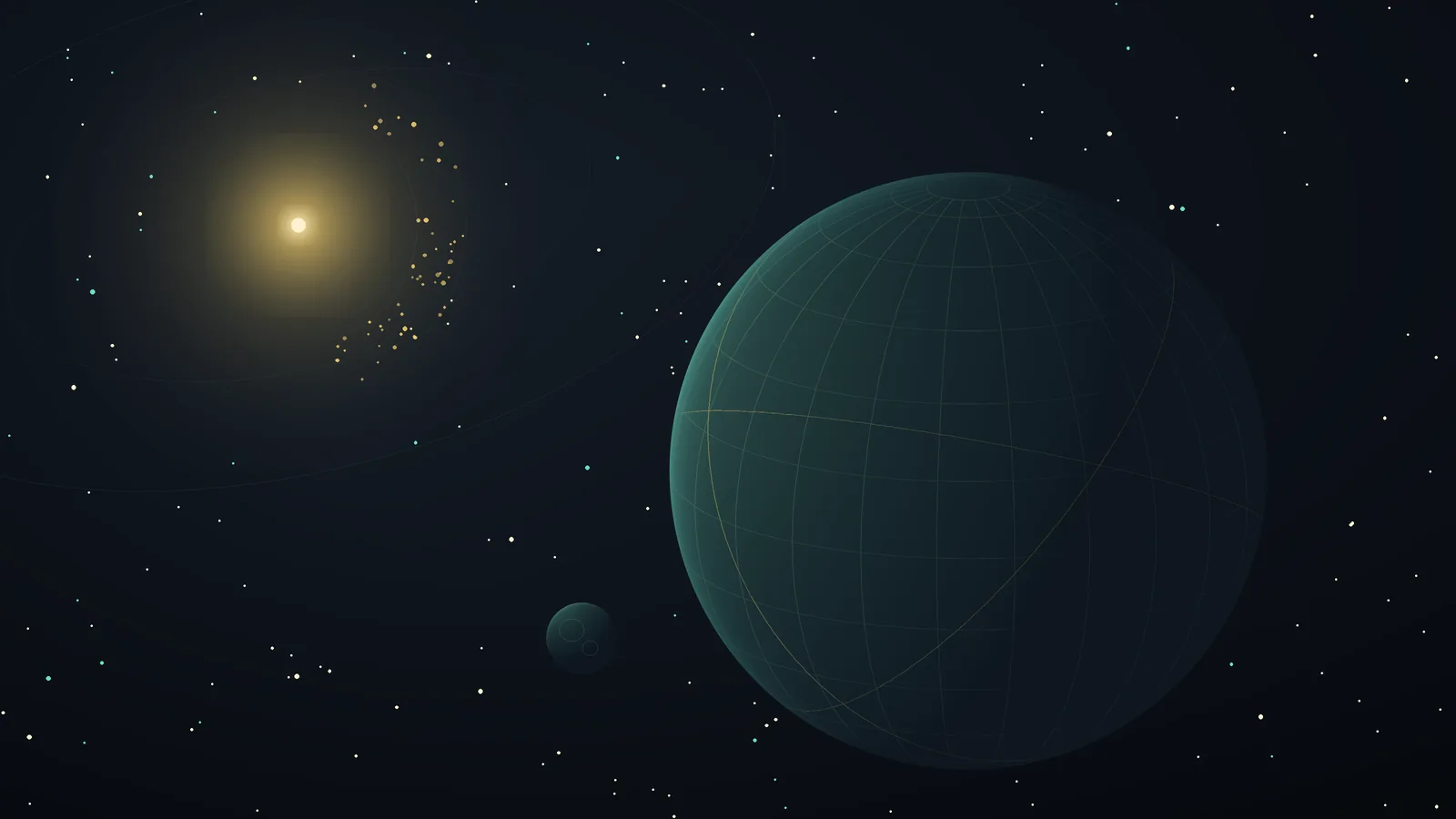
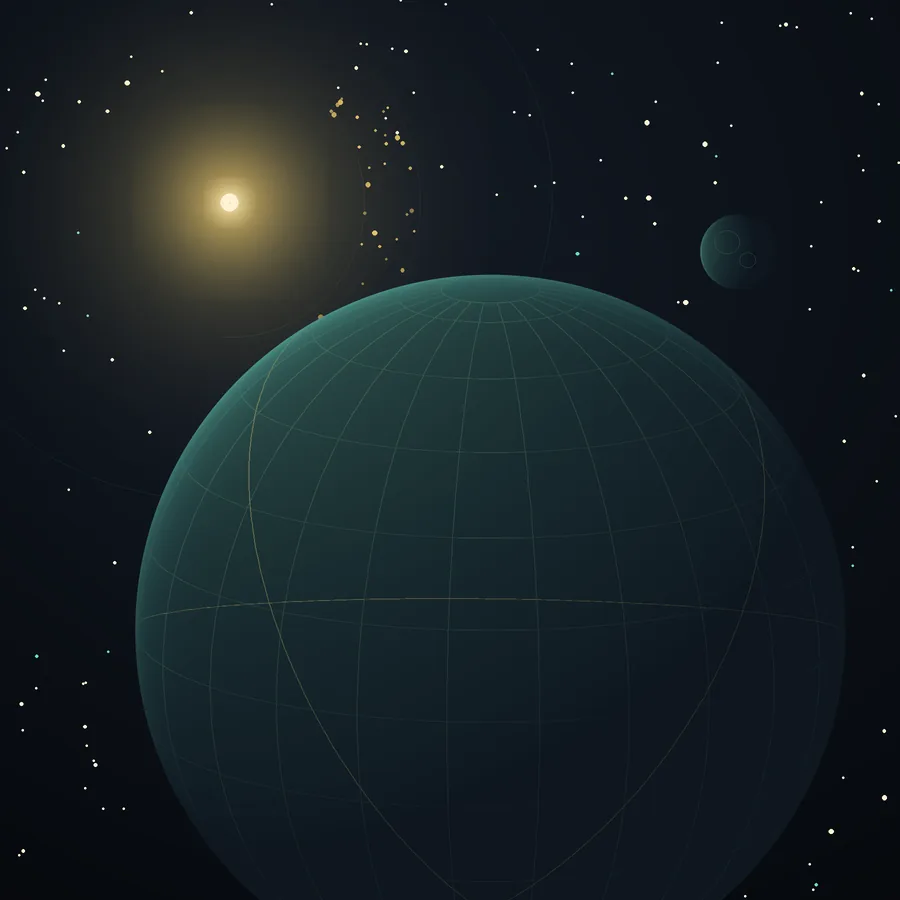
Cosmic Scale placeholder key art: a gridded planet and its Dyson swarm
Pre-Launch · Build In Public

Cosmic Scale isn't out yet.

No demo. No early access. No false claims. What is real: an itch.io page accepting follows so you'll be notified the moment there's something playable, a public roadmap, and a weekly devlog tracking exactly what's been built. Patrons get their name on the in-game Patron Wall when the game ships.

Core Systems

What you'll actually do.

Cosmic Scale is built on eight layered systems. Each one stands alone, and each one feeds the next as your factory grows from a mining laser to a planetary civilization.

From mining laser to express belts.

You land with a hand-held mining laser and an empty crafting bench. Point the laser at any node and hold to harvest. No fuel, no charge. Carve out your first ore. Smelt your first ingot. Connect a Mk.1 belt and watch the whole world change. By Tier 4 you're routing Mk.4 belts at 600 items/min through Manufacturers running four-input recipes, and the laser stays on your hip as a backup for when the factory stalls.

You build on a square-tile grid wrapped around the planet, which comes with a catch you can see from orbit: a sphere cannot be tiled in perfect squares. Twelve great fault lines run across every world where the tiling has to break. They're a rule of the world, not a bug. Belts cross them on fault lifts.

  • Crafting Bench · bootstrap recipes
  • Smelter / Foundry / Refinery · single & dual-input tier production
  • Assembler / Manufacturer · multi-input complex assemblies
  • Conveyor Splitters & Mergers · balanced routing
  • Express Belts · endgame throughput
Cosmic Scale placeholder key art: a gridded planet and its Dyson swarm

A grid that actually flows.

Cosmic Scale runs a real flood-fill power grid. Drop a generator, lay connected poles, attach your machines. The simulation balances production and consumption every tick. Overload a grid and your machines slow down proportionally. They don't pop, they just throttle. Catching power bottlenecks is a load-bearing part of the puzzle.

  • Biomass Burner (30 MW) · your Tier-0 starter, before you even unlock electricity
  • Coal Generator (90 MW) · T1 workhorse
  • Nuclear Reactor (2,500 MW) · Tier 4 baseline · spent-fuel disposal matters
  • Fusion Reactor (9,000 MW) · Tier 5 clean energy
  • Dyson Sphere Core (1 TW / 1,000,000 MW) · a single core feeds a terawatt into your factory, distributed across every connected grid in the world; the Type-1 victory itself is the swarm sustaining 10 PW
  • ▸ Three power-pole tiers + three battery-bank tiers + weather-driven generation (wind, tornado, lightning, hurricane)

Drones that just work.

Belts get you the first ten hours. Around Tier 5 you'll unlock the Drone Port: paint a route, drop a second port at the destination, and autonomous cargo drones fly it while you focus on the next problem. On a round world they take the great-circle arc, so a route across the planet looks like one. Drones don't replace belts; they shortcut them across distances belts can't cover. By endgame you'll have freight moving between continents AND between planets.

  • ▸ Up to 16 drones per port · auto-balanced
  • ▸ Per-port input & output buffers · filtered routes
  • ▸ Space elevators lifting cargo to geostationary orbital platforms
  • ▸ Freighters flying between planets that are genuinely moving → four trade-partner worlds
  • ▸ Routes survive save / load & chunk unload, so no freight goes missing

Twelve biomes, wrapped around real planets.

Every world is procedurally generated from a seed and tiled across a real sphere. Twelve hand-tuned biomes blend by moisture and temperature, each carrying its own primary terrain, danger budget, and resource economy. A planet type is a climate window, so different planet types carry different biome and resource mixes. The mid and late tech tree can't be finished from the home world alone. Mountains are honestly mid-rework. The multi-octave Perlin and ridge-noise generation exists, but it isn't good enough yet, so mountains are switched off in current builds while they get rebuilt properly.

  • ▸ Mountains under rework · disabled in current builds until they're right
  • ▸ Natural water bodies validated for size
  • ▸ Biome-locked resource spawning
  • ▸ Per-biome creature populations
  • ▸ A procedural galaxy of star systems beyond the home one
Tour all 12 biomes →

33 research nodes. 7 milestones. 8 tiers.

Research is granular: each of the 33 nodes unlocks specific recipes, specific machines, specific power sources. Milestones are bigger: story-gated checkpoints that crack open whole tiers. ARIA narrates your way through both, with different lines for first-time vs. repeat discoveries so the dialogue never repeats. She also notices the quiet ruin of a factory left idle for too long. Hit Type-1 Ascension and the Stellar tier opens.

  • 33 research nodes with prerequisites & durations
  • 7 milestones gating the eight tiers
  • 56 achievements with Steam-ready IDs
  • 88 recipes tied to specific machine types
Explore the tech tree →

Commanding a planet, one storm at a time.

This is the system that makes Cosmic Scale a Kardashev game, and it's a real production chain, not just a roadmap promise. Seven weather buildings burn input items, generate power, drive the planetary weather state, and produce byproducts that downstream machines depend on. The Type-1 Catalyst recipe, the literal capstone of the game, now requires a Cyclone Core as input, meaning you cannot reach Kardashev Type-1 ascension without orchestrating hurricanes on purpose.

The chain (Tier-4 → Tier-6):

  • Atmospheric Pressure Compressor · atmospheric_condensate → pressurized_air · drives Fog
  • Tornado Spire Mk1 · pressurized_air → storm_essence · drives Storm · 3,500 MW
  • Solar Storm Array Mk1 · concentrated_solar_film → lightning_charge · drives Clear · 3,000 MW
  • Lightning Capacitor Mk1 · lightning_charge → energy_cell · drives Storm · 4,000 MW
  • Hurricane Core Mk1 · storm_essence + water → cyclone_core · drives Storm · 4,500 MW
  • Cryo Plume Mk1 · drives Snow · 1,000 MW
  • Magma Tap Mk1 · water → quantum_foam · drives Clear · 5,000 MW

Endgame gate: Type-1 Catalyst requires 4 × Cyclone Core. The only way to make cyclone cores is to run the Hurricane Core. The only way to run the Hurricane Core is to be producing storm essence. The only way to do that is the Tornado Spire chain. Player-driven weather is the spine of the endgame.

▸ Read the Kardashev vision
ATMOSPHERIC COMPRESSOR → pressurized_air TORNADO SPIRE → storm_essence HURRICANE CORE → cyclone_core PLANETARY ASSEMBLER type1_catalyst recipe TYPE-1 CATALYST ASCENSION T4 T5 T5 T5 T7
The actual production chain. Cyclone cores are not optional: the Type-1 Catalyst recipe requires four of them.

Steam lobbies. Real shared factories. In development.

Co-op is planned for the Steam release and is being built now, into the 3D game rather than bolted on after it. The target is the thing that actually works in Satisfactory: the host opens a Steam lobby with an optional password, friends see the game in the Steam overlay and join with a click. No port-forwarding. No IP-pasting.

The design goal is a shared factory rather than a co-op patch on top of single-player. The host is authoritative, and the factory on your screen is the factory the host is actually simulating, not a stale snapshot from when you joined. Solo play stays its own untouched path with no networking overhead.

  • Steam Lobby + friend invite · open the overlay, click Join Game on a friend
  • Password-protected lobbies · friends-only by default, public if you want
  • Host-authoritative simulation · the host runs GameTick and every machine; clients get live state
  • Solo is not the lesser mode · the single-player path carries no networking cost

Being built on Unity Netcode for GameObjects + Facepunch.Steamworks + the community NGO Facepunch transport. Internet matchmaking via Steam Datagram Relay, with no NAT-punching and no third-party servers. It isn't finished, and there's no build to play yet.

CO-OP

The Dyson swarm is just the beginning.

Build to Tier 6 and the Dyson Frame Constructor unlocks. Manufacture orbital sails, charged energy cells, and dyson lenses; coordinate launches through the Orbital Launcher; assemble the swarm in five stages. Sustain it at 10 petawatts, the real Sagan boundary for a Kardashev Type-1 civilization, and the run is won. The Stellar tier opens (Pocket Black Hole Container, Star Lifter, Planet Power Stabilizer, the lot), and you can keep playing as long as you like.

  • Five-stage Dyson swarm · sustain it at 10 PW (10¹⁶ W, the Kardashev Type-1 boundary) to win
  • Pocket Black Hole Container · 10,000 MW from a stabilized singularity
  • Star Lifter Antenna · siphons raw stellar material from your home sun
  • Type-1 Ascension · the run's victory condition (then keep playing if you want)

"You'll know you're ready when the sun starts giving you more than it's taking. That's when the real engineering begins."

ARIA
Construction Schedule

Five stages. Ten petawatts.

Each stage adds sails to the swarm; its output climbs with sail count and your efficiency research, building toward the 10-petawatt Type-1 boundary. Launched in waves from the Orbital Launcher, assembled in orbit by drone swarms. Hover a ring to inspect its build manifest.

Stage 1 · Inner RingFirst sails

Hundreds of orbital sails, the charged energy cells to power them, a battery of dyson lenses to focus it all. The first ring teaches the chain.

Stage 2 · Tropic RingBuilding out

Double the sails, add a second Orbital Launcher. Storm essence demand spikes, so Tornado Spires go online.

Stage 3 · EquatorHalf the sky

Equatorial belt. Half the swarm is in orbit. Heavy stellar alloys come online for the rings ahead.

Stage 4 · Polar CapNear-total

Polar coverage. The weather-power chain runs flat out to feed the swarm. The Type-1 Catalyst recipe is now unlocked.

Stage 5 · Ascension10 PW · Type-1

The sphere closes. Type-1 Catalyst consumed. The Stellar tier unlocks: Star Lifter, Black Hole Container, the lot.

Eight Tiers of Progression

Eight ages, one factory.

Move from primitive crafting to stellar engineering. Each tier introduces new machines, new resources, and new logistics challenges. Click any tier below to see what it unlocks.

T0
PRIMITIVE
Mining laser
You land with a mining laser and a crafting bench. Wood, stone, plant fiber. Biomass burners feed the first electricity. Charcoal stations, foundations, walls. This is the “first 30 minutes” tier.
T1
COPPER
Smelters · Belts Mk.1
First smelter. First belt at 120 items/min. Copper plates, wire, cable. The factory starts to look like a factory. The Tier-1 milestone unlocks at the Space Elevator.
T2
IRON
Assemblers · Belts Mk.2
Iron rods, gears, screws. The Assembler joins the lineup with multi-input recipes. Coal generators replace biomass at scale. Splitters, mergers, and underground belts untangle the spaghetti.
T3
STEEL
Foundries · Oil
Steel ingots, beams, pipes. The Foundry handles dual-input recipes; the Refinery cracks oil into plastic + rubber. Fuel generators take you to 150 MW per unit. Belts Mk.3 at 360 items/min.
T4
ELECTRONICS
Circuits · Drones · Mk.4
Circuit boards, computers, AI limiters. Drone Ports for long-distance logistics. The Nuclear Reactor arrives at 2,500 MW. Belts Mk.4 at 600 items/min. The Atmospheric Pressure Compressor unlocks, the first step of the weather-control chain.
T5
QUANTUM
Particle Accelerator · Weather
Quantum Lab and the Particle Accelerator. The full weather-control chain comes online: Tornado Spire, Lightning Capacitor, Hurricane Core. Belts Mk.5 at 900 items/min. This is where the game stops being Factorio-with-a-twist and starts being a Kardashev game.
T6
PLANETARY
Dyson · Belts Mk.6
Megastructures: Dyson Frame, Dyson Lens, Graviton Lens, Orbital Sail. Planetary Assembler. Antimatter synthesis. Belts Mk.6 at 1,320 items/min: Kardashev-class throughput. To reach T7, you must craft the Type-1 Catalyst, which requires four Cyclone Cores from the weather network.
T7
STELLAR
Type-1 Ascension
Endgame. Singularity Core, Stellar Material, Type-1 Energy Matrix. Pocket Black Hole reactors. Star Lifters. The five-stage Dyson Sphere completes; the credits roll on a Type-1 civilization built one belt at a time.
Twelve Biomes

Every world is a story.

From quiet grasslands to lavender crystal plains, each biome has its own resources, threats, and aesthetic identity.

The Vision · Kardashev Type-1

Not just a factory game. A civilization scale.

In 1964, Soviet astronomer Nikolai Kardashev classified civilizations by how much of their star's energy they can actually harness. Type-1 captures every watt that hits a planet: every wave, every wind current, every storm. Type-2 captures the full output of the star. Type-3 captures an entire galaxy. Each rung is roughly ten billion times more powerful than the one below it. Cosmic Scale is built around this idea: most factory games stop at a rocket, this one keeps going.

TYPE I PLANETARY ~10¹⁶ watts every joule on the planet TYPE II STELLAR ~10²⁶ watts an entire solar system TYPE III GALACTIC ~10³⁶ watts an entire galaxy

Tornado Spires T5

Mountain-cap superstructures that convert managed cyclonic storms into raw electricity. Yields scale with biome wind profile.

Hurricane Cores T5

Ocean-stationed pressure-differential plants that pull energy from controlled hurricanes. Output is enormous.

Solar Storm Arrays T5

Atmospheric collectors that harvest charged-particle bursts during solar maxima. Bursty; pairs with Charged Energy Cells.

Atmospheric Compressors T4

Pulls Pressurized Air from ambient atmosphere. Bridge from chemistry to weather control.

Planetary Shield T6 · CAPSTONE

Containment field that locks the engineered atmosphere in place. The Type-1 capstone building.

Storm Essence T5 · MATERIAL

Captured ionized atmosphere from controlled storms. Intermediate material. Without it, no Type-1 transition.

Most factory games stop at a rocket. I want to keep going.

I love Factorio. I love Satisfactory. I love Dyson Sphere Program. But once you've launched the rocket, the game tells you you've won. Roll credits. Cosmic Scale rejects that ending. The Space Elevator isn't the win. It's the halfway point. The real climb is when your factory stops competing with the planet and starts commanding it. That climb is what the Kardashev scale describes.

Honest scope note: Cosmic Scale is being built in full 3D now, and that's the version going to Steam. Years of design work came with it intact: the items, buildings, recipes, research, biomes, and the weather chain above. What's running in-engine today is the part I'd want judged first: real planets you walk, orbits that actually orbit, space elevators and freighters and cargo drones moving real cargo. What's still ahead is the rest of the Tier-6 endgame, the Stellar-tier capstones, co-op, and the art pass that makes it all look like a finished game. None of it is in a public build yet; the game isn't released, and I'm not naming a date. The roadmap tracks exactly what's built, what's in progress, and what's planned.
Content at a Glance

Every number below is hand-tuned.

7Milestones
4Trade Planets

"Oh, hello! I'm ARIA, the Autonomous Resource Integration Assistant. I'll be your guide on this world."

ARIA, your in-world companion
Tech

Built on real engineering.

ENGINE
Unity URP (Universal Render Pipeline)
WORLD
Full 3D: spherical planets built from a square-tile grid wrapped around the sphere, with 12 great fault lines where square tiling has to break
ORBITS
Planets and moons genuinely orbit, so day/night, moon phases, and freighter launch windows fall out of the orbits instead of being scripted
SIMULATION
EventBus<T> zero-allocation events, ISaveable JSON persistence, flood-fill power grid
PROCGEN
Multi-octave Perlin biomes, ridge-noise mountain heights, smoothed single-cell anomaly removal, a procedural galaxy of star systems beyond the home one
PLATFORMS
PC (Windows) · Steam · itch.io · (Steam co-op is in development for the release, not shipped)
SAVES
HMAC-SHA256 signed JSON envelopes · Steam Cloud
FAQ

Frequently asked questions about Cosmic Scale.

What is Cosmic Scale?

Cosmic Scale is a hand-crafted 3D factory game built solo in Unity by OakTree Games. You land on a real spherical world with a hand-held mining laser and grow a civilization all the way to wrapping a star in a Dyson swarm. It spans twelve hand-tuned biomes, 106 items, 134 buildings, 33 research nodes, and eight tiers of technology.

Who makes Cosmic Scale?

Cosmic Scale is made by Kyle, the solo developer behind OakTree Games. Every line of code, every recipe, and every weekly devlog is written and built by one person, typically on Saturdays and late evenings after his first child is down for the night.

When is Cosmic Scale releasing?

Cosmic Scale is in active pre-launch development. The full release will land on itch.io and Steam. Follow the project on itch.io to be notified the moment the first public build is available, or read the public roadmap to track upcoming features.

What platforms will Cosmic Scale support?

Cosmic Scale targets PC (Windows) on launch via itch.io and Steam. Console ports (Switch, PlayStation, Xbox) are on the long-term roadmap once the desktop release stabilizes.

Is Cosmic Scale a Factorio or Satisfactory clone?

Cosmic Scale shares the same DNA (conveyor belts, recipes, automation, fluid logistics), but the world is a real 3D planet you walk all the way around, the worldgen is biome-driven and procedurally generated, the planets and moons genuinely orbit, and the endgame is a five-stage Dyson swarm that proportionally distributes power across every connected grid in the world. There's also an AI companion (ARIA) that narrates the entire run with deadpan personality.

Does Cosmic Scale have multiplayer or co-op?

Co-op is planned for the Steam release and is in development. It isn't finished, and there's no build to play yet. The target is a real shared factory rather than a co-op patch: the host opens a Steam lobby (optional password), friends join from the Steam overlay with one click, no IP-pasting or port-forwarding, and the host streams the live simulation to each client. Solo play stays the untouched single-player path with zero networking overhead.

How do I support development of Cosmic Scale?

The most direct way is becoming a patron at any of the three tiers (Sapling, Sprout, Oak) or dropping a one-time tip on the support page. Any patron tier locks in a free copy of the game at launch and a name on the in-game Patron Wall. If you want to shape the roadmap, tell me directly: itch.io comments or hello@oaktree-games.com both reach me. Following on itch.io and sharing the project also genuinely helps.

What engine and tech does Cosmic Scale use?

Cosmic Scale is built in Unity URP using C# and HLSL shaders, in full 3D. Each planet is a sphere carrying a square-tile building grid, with twelve great fault lines where that tiling has to break. Under it sits a deterministic 10 TPS GameTick, a zero-allocation EventBus, and ScriptableObject-driven data for every item, building, recipe, and biome. The save system uses an `ISaveable` interface with `saveId` string references so saves survive refactors.

What is OakTree Games?

OakTree Games is a one-person indie game studio founded by Kyle. The studio name comes from the idea that good games grow slowly, like oak trees: one ring at a time. Cosmic Scale is the studio's flagship project. Infinite Initiative, a free browser deckbuilding roguelike, is already live on itch.io, and Cc: is a small game-jam build from the same bench.

Ready to start your civilization?

Cosmic Scale is in active solo development. The fastest way to be ready for the launch is to follow on itch.io now, and support the build so I can keep shipping every weekend.